 Skip-the-line available
 Munich Residenz Tickets: Choosing How Much to See
The Munich Residenz is three attractions under one roof, and the only real decision is how much of it you want to see on your visit.
The Munich Residenz is not one museum but three separate sights sharing a single vast palace. Your ticket choice comes down to a simple question: how much of the former royal city palace do you want to see?
Three attractions under one roof
Most first-time visitors arrive expecting a single palace tour and are surprised to learn that the Residenz holds three distinct experiences, each with its own entrance ticket or a combined one. This grew out of history rather than marketing. Over roughly 450 years the Wittelsbach dukes, prince-electors and kings kept adding wings, courtyards and collections to what began as a small moated castle in 1385, until it became one of the largest and most important city palaces in Europe. What you buy a ticket for today is really a cluster of that legacy. First is the Residence Museum, some 130 rooms of state apartments, halls and period interiors. Second is the Treasury, or Schatzkammer, a compact but astonishing collection of crowns, regalia and goldsmith work. Third is the Cuvilliés Theatre, a rococo court theatre tucked into the palace complex. They occupy the same address but are curated, ticketed and even timed as separate destinations. The practical consequence is that your decision is not whether to visit but how much to take in. A traveller with two spare hours and a single headline interest, the great frescoed Antiquarium, say, might see only the museum. Someone spending a full morning and wanting the crown jewels alongside the state rooms adds the Treasury. Anyone who wants the complete Residenz, theatre included, sees all three. This guide walks through what each part contains, sets out our three ticket tiers and their prices, and explains exactly how entry, timing and our concierge booking work. Understanding the layout before you choose spares you the most common regret we hear, which is buying the smallest ticket and discovering, once inside, that the piece you most wanted to see needed a different one. A little planning turns a good visit into a complete one.
The Residence Museum and the Antiquarium
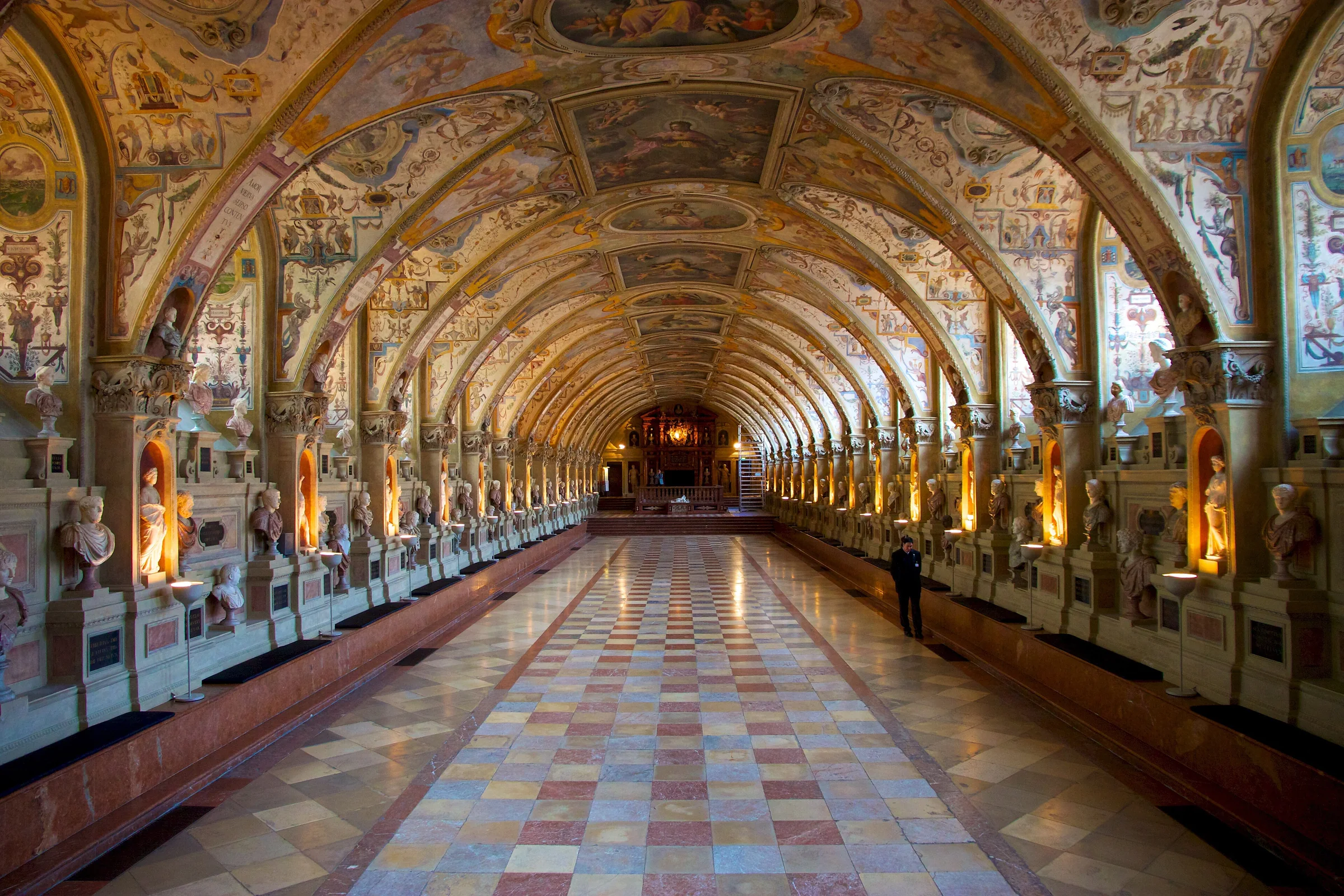
The Residence Museum is the heart of any visit and the part every ticket tier includes. Its route threads through around 130 rooms, a genuinely long walk that rewards an unhurried pace. The undisputed showpiece is the Antiquarium, a barrel-vaulted Renaissance hall stretching 66 metres and frescoed from end to end. Built in the sixteenth century to display the dukes' collection of antique sculpture, it is the largest Renaissance interior north of the Alps, and stepping into its low, luminous vault is the moment most visitors remember. Beyond it, the museum unfolds as a sequence of moods. The Ancestral Gallery, or Ahnengalerie, lines a corridor with gilded portraits of the Wittelsbach line, a dynasty tracing itself back across centuries. The royal apartments and state rooms move through changing tastes, from Renaissance through baroque and rococo to neoclassical, each ruler leaving his own layer of decoration. There are private chapels, richly worked ceilings, tapestries, porcelain and period furniture arranged much as court life would have used them. It is worth remembering as you walk that almost all of this is reconstruction. The Residenz was very heavily destroyed by bombing during the Second World War, and what you see is the fruit of decades of painstaking restoration, rebuilt room by room from records, salvaged fragments and old photographs. Knowing that adds weight to the detail rather than diminishing it. Because the museum is large and its highlights are spread across the route, an audio guide is included with the Residence Museum ticket, letting you follow the rooms at your own pace and dwell on what interests you. Allow at least ninety minutes for the museum alone, and closer to two hours if you like to read, listen and linger. Comfortable shoes matter more here than at almost any other Munich sight.
The Treasury: crowns, regalia and a thousand years of gold
The Treasury, known in German as the Schatzkammer, is the second attraction and the one most people add to their museum ticket. Where the Residence Museum impresses through scale and space, the Treasury concentrates its wonder into a series of darkened rooms glittering with worked precious metal. It ranks among the most important collections of European goldsmith work and royal insignia anywhere, and its span is remarkable: roughly a thousand years of crowns, swords, sceptres, reliquaries, jewels and regalia gathered by the Bavarian rulers. Cases hold pieces you would otherwise only meet in history books, from small medieval devotional objects encrusted with gemstones to full coronation regalia and the personal insignia of prince-electors and kings. The craftsmanship rewards slow looking. Enamels, engraved rock crystal, pearls and settings of extraordinary fineness reveal themselves only when you lean in, so the Treasury feels intimate in a way the great halls upstairs do not. It is also more compact, which makes it an efficient addition to a visit rather than a second exhausting circuit. Most people spend forty-five minutes to an hour here, though enthusiasts of goldsmithing or medieval history happily lose longer. Because it is a separate attraction, the Treasury is not covered by a museum-only ticket; you need either the Museum-plus-Treasury tier or the all-inclusive tier to enter it. That distinction trips up more visitors than any other at the Residenz, so it is worth deciding before you arrive whether the crown jewels are part of the day you want. For most travellers with an interest in royal history, pairing the Treasury with the museum is the combination that best captures what the Residenz was: not only a place where the Wittelsbachs lived, but the vault where they kept the symbols of their power.
The Cuvilliés Theatre, a rococo jewel box
The third attraction is the Cuvilliés Theatre, and it is the one that turns a thorough visit into a complete one. Designed by François de Cuvilliés, the court architect who gave much of Munich its rococo character, it is a small, breathtakingly ornate court theatre of red and gold. Tiers of carved and gilded boxes rise around an intimate auditorium, every surface alive with cherubs, garlands and scrollwork, the whole room a single sustained flourish of eighteenth-century decoration. It is often described as one of the loveliest theatres in Europe, and standing in the empty auditorium, with the boxes glowing above you, it is easy to see why. Like the Residenz around it, the theatre survived the war only because its carved decoration was dismantled and stored for safety, then reinstalled once a new home could be built; what you see is the original rococo carving, preserved and returned. There are two practical points to keep in mind. First, the Cuvilliés Theatre is included only in the top ticket tier, alongside the museum and Treasury, so if seeing it matters to you, choose the all-inclusive option rather than adding it separately on the day. Second, and this is the detail most easily missed, the theatre frequently keeps shorter or different opening hours than the museum, and it can close on certain public holidays or when it is in use. Because it is a working performance space as well as a monument, access is more restricted than for the galleries. We always recommend checking the current theatre hours for your chosen date at the time you book, so that a top-tier ticket does not arrive on a day when the theatre happens to be shut. Visited at the right moment, it is the quiet highlight of the whole Residenz.
Our three ticket tiers and prices
Because the Residenz is three attractions, we offer three ticket tiers, and choosing between them is simply a matter of how much you want to see. The prices below are per person for the tickets we book and arrange on your behalf. The first tier is the Residence Museum at our standard rate, which covers the full museum route, the Antiquarium, the Ancestral Gallery and the royal apartments, with the audio guide included. This suits visitors whose main interest is the state rooms and who are content to skip the crowns and the theatre. The second tier, Museum plus Treasury at the combination rate, is the most popular combination and the one we recommend for most first-time visitors. For a modest step up it adds the Schatzkammer to the full museum, giving you both the grand interiors and the royal regalia in one visit. The third tier, Museum plus Treasury plus Cuvilliés Theatre at the all-inclusive rate, is the see-everything ticket. It opens all three attractions, the museum, the Treasury and the rococo theatre, and is the right choice for anyone who wants the complete Residenz and does not want to discover a closed door on the day. On pricing there are two things worth knowing. Children and young people under 18 enter free; this is not a paid ticket you buy from us but a free admission granted at the door, so families only pay for the adults in the party. Reduced rates apply to certain eligible visitors, such as EU seniors and disabled guests, and both reduced and free admissions require original valid proof of eligibility shown on site. Bring the relevant identification with you, because eligibility cannot be verified after the fact. Weigh the tiers against your time and interests rather than price alone; the gap between them is small next to the difference in what you get to see.
How entry and timing actually work
It helps to know exactly what your ticket does and does not do before you arrive, because the Residenz works a little differently from attractions with rigid timed entry. Your ticket is date-based: it is valid for the date you choose, and you enter at your own convenience during opening hours on that day. It is not a fixed thirty-minute slot, so there is no exact minute you must present yourself, and equally no guaranteed instant queue-jump tied to a precise time. What the ticket does give you is a settled reservation for your date and, crucially, a print-at-home ticket that lets you walk past the on-site cash desk rather than queuing to buy one. On a busy afternoon in high season that saved queue is the real convenience. Inside, the museum is self-guided. You follow the route through the rooms at your own pace with the included audio guide, pausing where you like, which is why it is impossible to put a fixed duration on a visit; some people move through in ninety minutes, others take far longer. Opening hours shift with the season. From late March to about mid or late October the museum runs roughly 09:00 to 18:00, with last admission around 17:00. From late October to late March it runs roughly 10:00 to 17:00, with last admission around 16:00. Aim to arrive at least an hour and a half before last admission, and longer if you have a combined ticket, so you are not rushed through the final rooms. Remember too that the Cuvilliés Theatre often keeps shorter hours than the museum and closes on some public holidays, so a top-tier day is best planned around the theatre's window. Seasonal details can change, so confirm the exact hours for your chosen date when you book.
Booking with our concierge and finding the Residenz
We are a concierge service: we book and arrange your Residenz tickets so you can plan your visit with a confirmed date and a ticket ready to print before you leave home, rather than joining the cash-desk line on arrival. You tell us the date and the tier, museum only, museum with Treasury, or the all-inclusive ticket with the theatre, and we handle the arrangement and send you a print-at-home ticket for that day. It is a facilitation service built around convenience and clear guidance, not a box office, and it is especially useful for travellers who want the details settled in advance and in plain English. A note on our terms: because each ticket is arranged for a specific date, all sales are final, and we can only offer a refund in the event that the attraction itself fails to honour a valid ticket. Choosing your tier carefully before you book is therefore worth a moment's thought. Getting there is easy, because the Residenz sits in the very centre of Munich. The entrances are on Residenzstraße and Max-Joseph-Platz, a few minutes' walk from Marienplatz and Odeonsplatz. The nearest U-Bahn and S-Bahn stations are Odeonsplatz and Marienplatz, and Munich's main station, the Hauptbahnhof, is about fifteen minutes on foot or a short underground ride away. Arriving from the airport, the S-Bahn lines S1 and S8 reach Marienplatz or Odeonsplatz in roughly forty minutes. Because you are already in the old heart of the city, it is worth building a day around the visit: the Glockenspiel at Marienplatz, the Frauenkirche, the Theatinerkirche on Odeonsplatz and the free Court Garden beside the palace are all within a short stroll, with the Hofbräuhaus, Viktualienmarkt and the English Garden a little further on.
Frequently asked
How many tickets do I need for the Munich Residenz?
One ticket per adult, at the tier you choose. The Residenz is three attractions, so your single ticket covers either the museum alone, the museum with the Treasury, or all three including the Cuvilliés Theatre. Under-18s enter free and need no paid ticket, so families only buy for the adults.
Which ticket includes the Treasury and the Cuvilliés Theatre?
The Treasury is included in the Museum-plus-Treasury tier at the listed rate and in the top tier at the listed rate. The Cuvilliés Theatre is included only in the top tier, alongside the museum and Treasury. The 22-euro museum ticket covers neither, so choose your tier by what you want to see.
Is my ticket a fixed timed slot?
No. Entry is date-based, valid for the day you choose, and you enter at your own convenience during opening hours. It is not a fixed thirty-minute slot. Your print-at-home ticket does let you skip the on-site cash-desk queue, which is the real time-saver on busy days.
Do children really enter free, and what about reduced tickets?
Yes. Children and young people under 18 enter free; it is a free admission at the door, not a ticket you buy. Reduced rates apply to eligible visitors such as EU seniors and disabled guests. Both free and reduced admissions require original valid proof of eligibility shown on site, so bring your ID.
Is the museum guided, and how long should I allow?
The Residence Museum is self-guided at your own pace, with an audio guide included. Allow at least ninety minutes for the museum, closer to two hours if you linger, and add roughly an hour for the Treasury. Arrive well before last admission, especially with a combined ticket, so you are not rushed.