 Skip-the-line available
 Visiting the Munich Residenz: A Practical Guide
Everything you need to plan a smooth visit to the Munich Residenz — seasonal opening hours, how long to allow, what to see, and how to get there.
The Munich Residenz is the vast former royal palace of the Wittelsbachs, right in the heart of the city. This practical guide covers hours, timing, what to see, and how to arrive relaxed.
Opening hours through the year
The Munich Residenz keeps two seasonal timetables, so the first thing to settle is when you plan to come. From late March to around late October the doors are open roughly 09:00 to 18:00, with last admission about an hour before closing, near 17:00. From late October through to late March the palace runs shorter winter hours, roughly 10:00 to 17:00, with last admission near 16:00. Those closing times are firm, and the galleries begin gently winding down before the very end, so arriving well ahead of last admission gives you room to see everything at a comfortable pace rather than a hurried march. The Cuvilliés Theatre is worth flagging separately. Because it is a working court theatre as well as a sight, it frequently keeps shorter or simply different hours from the main museum, and it can close to visitors when it is in use. If seeing the rococo theatre matters to you, treat its hours as the fixed point of your day and build the rest of the visit around it, confirming the current schedule when you book. The Residenz also closes on a small number of public holidays through the year, so a date that falls on or beside a major holiday is always worth double-checking before you travel. Because entry to the Residenz is valid for your chosen date rather than a fixed timed slot, you are free to arrive whenever suits you within opening hours — there is no single minute you must appear. That flexibility is a real convenience, but it works best paired with a little planning: pick your date, note the season's closing time, and give yourself a generous margin before last admission so nothing feels rushed.
The best time to visit and how long to allow
For the calmest experience, come early. The first hour or two after opening is reliably the quietest, when the state rooms are hushed and you can stand in front of the great halls without a crowd drifting through your photograph. Late morning and early afternoon are the busiest stretch, especially in the warmer months and at weekends, while the last couple of hours before closing quieten down again — though a late start leaves less margin if you want to see all three parts. A midweek morning outside the summer peak is close to ideal. How long you allow depends on how much of the Residenz you choose to see. The Residence Museum on its own — the state apartments, the Antiquarium, the Ancestral Gallery and the royal rooms — comfortably fills around 90 minutes to two hours at an unhurried pace, and easily more if you follow the included audio guide closely or love a particular room. Add the Treasury and its thousand years of crowns and regalia, and you should set aside roughly another 45 minutes. Add the Cuvilliés Theatre on top and you'll want a further 20 to 30 minutes to take in the tiers of carved and gilded boxes. Put all three together and you are looking at a genuine half-day inside the palace. There is no obligation to do everything in one go, but if you intend to, plan an early start so the closing time never becomes the thing that decides when you leave. If your time is shorter, the Museum-and-Treasury combination is the popular middle path: it captures the grandest interiors and the dazzling regalia in a visit of two to three hours.
What you'll see inside
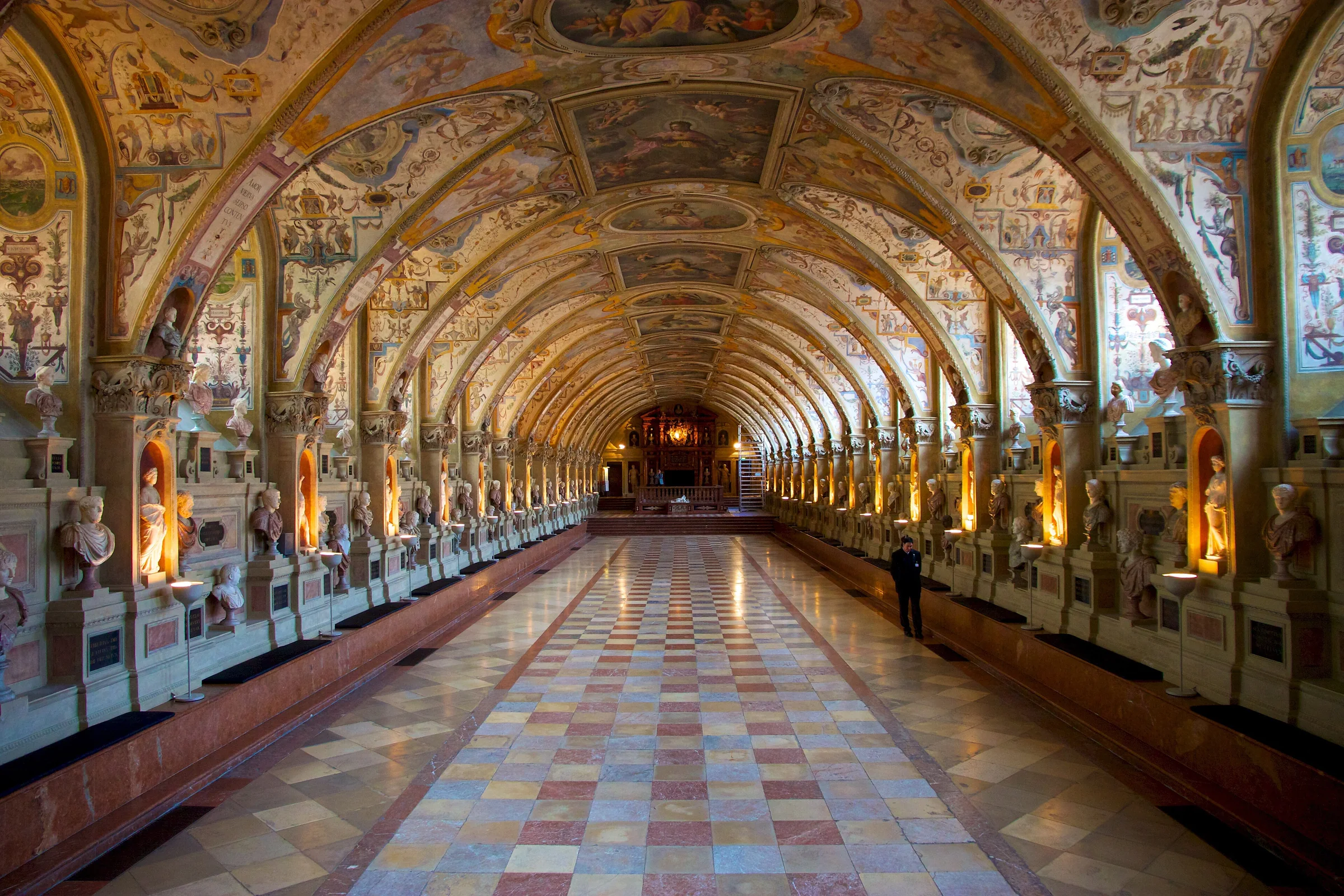
A visit to the Residenz spans three separate attractions under one roof, and the meaningful choice is simply how much of it you take in. The Residence Museum is the heart of the palace: around 130 rooms of state apartments, halls, chapels and collections that grew over some 450 years, from a modest castle begun in 1385 into one of the largest city palaces in Europe. Its showpiece is the Antiquarium, a 66-metre barrel-vaulted Renaissance hall frescoed from end to end, built in the 16th century to hold the dukes' antiquities — the largest Renaissance interior north of the Alps, and a genuine gasp of a room. Nearby, the Ancestral Gallery lines a long golden corridor with portraits of the Wittelsbach line, and the royal apartments carry you through richly furnished period rooms that trace the dynasty's taste across the centuries. The Treasury, or Schatzkammer, is a different kind of marvel: one of Europe's most important collections of goldsmith work and royal insignia, gathering crowns, swords, reliquaries, jewels and regalia spanning a thousand years into a series of glittering vaults. The Cuvilliés Theatre completes the trio — a jewel of a rococo court theatre designed by François de Cuvilliés, its tiers of red-and-gold carved boxes rising in a small, intense sweep of Baroque theatricality. It is easy to forget, moving between these dazzling interiors, that the Residenz was very heavily destroyed by bombing in the Second World War and painstakingly rebuilt over decades; much of what you see is the fruit of that long reconstruction. Beside the palace lies the Court Garden, or Hofgarten, a formal Renaissance garden that is free and open to all — a pleasant place to pause before or after your visit.
Self-guided at your own pace
The Residence Museum is seen self-guided, which suits the building perfectly. There is no fixed tour to keep step with and no set route you must follow minute by minute — you move through the rooms at your own rhythm, lingering where something catches you and passing quickly through what interests you less. An audio guide is included with the Residence Museum, and it is well worth using: it turns a beautiful set of rooms into a story, explaining who lived here, what each hall was for, and the details that are easy to walk straight past. Give yourself permission to follow it loosely rather than treating it as a checklist. The layout can feel like a maze on a first visit — that is part of the pleasure of a palace this size — so glance at the plan you're given at the start and don't worry about doubling back; almost everyone does. Photography for personal use is generally welcome in the museum, though flash and tripods are the usual exceptions, and you should always follow the signs and any direction from staff on the day, as some areas or temporary displays can be restricted. Large bags, backpacks and coats normally need to go into the cloakroom before you enter the galleries, both to protect the interiors and to make your own visit easier — it is far more comfortable to walk the state rooms unencumbered. Buying your ticket online in advance means you arrive as a print-at-home visitor and can head past the cash-desk queue, which is the single biggest time-saver on a busy day. Keep your ticket handy for entry, and if you hold a reduced or free ticket, carry the original proof of eligibility, since it must be shown on site.
Accessibility and comfort
The Residenz is a very large historic palace, and a full visit involves a good deal of walking across its many rooms and connecting halls, so comfortable shoes make a real difference. The building has been adapted over its long reconstruction to welcome a wide range of visitors, with step-free access to many parts of the museum via lifts, though as with any centuries-old palace a handful of areas retain historic steps, thresholds or floor levels that cannot easily be altered. Visitors with reduced mobility, and those travelling with them, are well provided for, and reduced-rate tickets apply to eligible visitors such as the disabled, with valid proof shown at entry. If a specific route or facility is essential to your visit, it is sensible to confirm the current arrangements when you book so there are no surprises on the day. Seating is dotted through the galleries, which makes it easy to pause and rest between rooms — a genuine help across a visit that can run to a half-day if you see all three parts. The included audio guide adds another layer of comfort, letting you absorb each room at your own pace without straining to read every label. Families should know that children and young people under 18 enter free, which makes the Residenz an easy choice for a day out with children, though the sheer scale rewards a plan: seeing the Antiquarium, a stretch of the state rooms and perhaps the Treasury is often more rewarding with younger visitors than attempting every last gallery. Cloakroom facilities for coats and larger bags keep the walk through the state rooms unencumbered, and pacing the visit — a rest in the Court Garden, a slower loop through the rooms that most appeal — turns a big palace into a relaxed morning.
Getting there
The Residenz could hardly be more central. The address is Residenzstraße 1, with entrances on Residenzstraße and Max-Joseph-Platz, and it sits just a few minutes' walk from both Marienplatz and Odeonsplatz in the very core of Munich. If you are exploring the old town on foot, you are almost certainly already close: the palace is woven into the same compact centre as Marienplatz, the Frauenkirche and the Theatinerkirche. By public transport, the nearest stops are Odeonsplatz and Marienplatz, both served by the U-Bahn and S-Bahn, and either leaves you a short, flat stroll from the entrance. From Munich's main station, the Hauptbahnhof, it is roughly a 15-minute walk or a quick U-Bahn hop, which makes the Residenz an easy first stop if you have just arrived in the city by train. Coming from the airport is simpler than many visitors expect: the S-Bahn lines S1 and S8 run from Munich Airport into the centre in around 40 minutes, dropping you at Marienplatz or Odeonsplatz within a few minutes' walk of the palace, with no need for a taxi or transfer. Driving into the middle of Munich is best avoided, as the centre is dense and parking is limited and costly; the train and U-Bahn network is far the more relaxed way to arrive. Once you are there, the location pays dividends for the rest of your day. The free Court Garden is right beside the palace, and Odeonsplatz, the Theatinerkirche, Marienplatz with its Glockenspiel, the Viktualienmarkt and the Hofbräuhaus are all within an easy walk — so the Residenz slots naturally into a wider morning or day exploring the heart of the city, with the English Garden and, a little further out, Nymphenburg Palace within reach if you have more time.
Choosing how much to see
Because the Residenz is really three attractions in one, the decision that shapes your visit is simply how much of it you want to take in — and it is worth making that choice before you arrive rather than at the door. The first option is the Residence Museum on its own, at our standard rate per person, which covers the state rooms, the Antiquarium, the Ancestral Gallery and the royal apartments. It is the essential Residenz and a satisfying visit in its own right, and for many people with a morning to spare it is exactly the right amount. The most popular choice is the Museum together with the Treasury, at the combination rate, which adds the Schatzkammer's crowns, swords, reliquaries and regalia to the grand interiors — a pairing that captures both the scale of the palace and its concentrated glitter without committing to a full half-day. If you want to see everything, the combined Museum, Treasury and Cuvilliés Theatre ticket, at the all-inclusive rate, opens all three parts, including the rococo theatre — the fullest experience, and the one to pick if the theatre is on your list, remembering that it may keep different hours. Reduced rates apply to eligible visitors, such as EU seniors and the disabled, with valid proof shown at entry, and children and young people under 18 enter free rather than needing a paid ticket. As a concierge service we book and arrange your date-valid entry so it is ready to print at home, which lets you walk past the cash-desk queue on the day. A quick word on planning: if there is any chance you will want the Treasury or the theatre once you are inside and swept up in the palace, it is easier and often better value to choose the wider ticket at the outset than to decide room by room. All sales are final, with refunds only in the event of an operator failure, so pick the tier that matches the time you genuinely have.
Frequently asked
How long should I allow for the Munich Residenz?
The Residence Museum alone takes about 90 minutes to two hours at an unhurried pace. Add roughly 45 minutes for the Treasury and 20 to 30 minutes for the Cuvilliés Theatre. Seeing all three is a genuine half-day, so start early if you plan to see everything.
What time of day is best to visit?
The first hour or two after opening is the quietest, with the state rooms hushed and easy to photograph. Late morning and early afternoon are busiest, especially in summer and at weekends. A midweek morning outside the peak season is close to ideal for a calm, unhurried visit.
Is my ticket for a fixed entry time?
No. Entry is valid for your chosen date rather than a fixed timed slot, so you can arrive whenever suits you within opening hours. Booking online in advance lets you skip the cash-desk queue. Note that the Cuvilliés Theatre often keeps shorter or different hours than the museum.
Do children need a ticket?
Children and young people under 18 enter free, so there is no paid ticket to buy for them. Reduced rates also apply to eligible visitors such as EU seniors and the disabled. Any free or reduced entry requires original proof of eligibility to be shown at the entrance.
How do I get to the Residenz from Munich Airport?
Take the S-Bahn line S1 or S8 from Munich Airport into the city centre — about 40 minutes — and get off at Marienplatz or Odeonsplatz. From either stop the palace at Residenzstraße 1 is only a few minutes' walk. There is no need for a taxi or transfer.