 Skip-the-line available
 The Antiquarium and Treasury: Two Great Showpieces
A close look at the Antiquarium's 66-metre vault, the royal state rooms, and a Treasury of crowns and goldsmith work spanning a thousand years.
Two rooms explain why the Munich Residenz matters. One is a 66-metre Renaissance hall lined with antique busts; the other is a vaulted Treasury of crowns and gold. This guide reads both closely.
Two showpieces at opposite ends of the collection
The Munich Residenz grew over roughly 450 years, from a modest castle begun in 1385 into one of the largest city palaces in Europe, and a full visit spans three separate attractions under one roof. Two of them stand out above the rest, and they could hardly be more different in character. The first is the Antiquarium, a colossal Renaissance hall buried at the heart of the Residence Museum, built in the sixteenth century to display the ruling dukes' collection of antiquities. The second is the Treasury, or Schatzkammer, a hushed suite of rooms holding one of Europe's foremost collections of goldsmith work and royal insignia. Between them they tell the story of the Wittelsbachs twice over: once as Renaissance princes reaching back to ancient Rome for prestige, and once as a dynasty of dukes, prince-electors and kings accumulating crowns, swords and reliquaries across a thousand years. This guide slows down on both. It walks the length of the Antiquarium's frescoed vault, pauses over the Ancestral Gallery and the great state rooms that surround it, then crosses to the Treasury to read its cases in the order the objects were made. A word on how you will see all this: the museum is self-guided, at your own pace, with an audio guide included, and entry is valid on your chosen date rather than tied to a fixed slot. That freedom matters here more than at most palaces, because both showpieces reward the visitor who is willing to stand still. The Antiquarium asks you to look up; the Treasury asks you to lean in. Neither is a room to hurry through, and the combined ticket that covers both is the choice most visitors are glad they made.
The Antiquarium: a Renaissance hall like no other
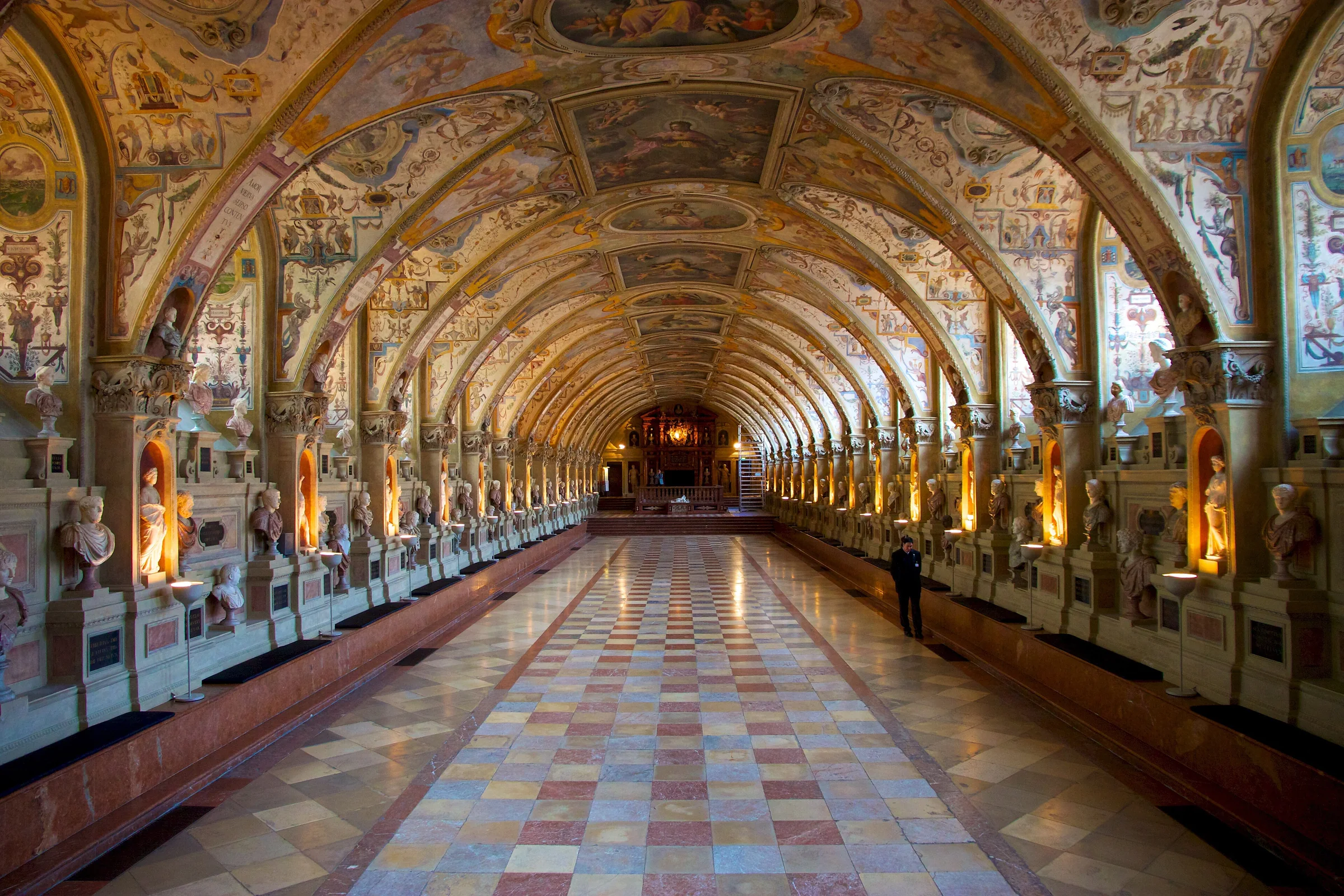
Descend to the lower level of the Residence Museum and the corridors suddenly open into the Antiquarium, and the scale of it stops most people mid-step. The hall runs about 66 metres end to end beneath a single low, barrel-vaulted ceiling, and it is the largest Renaissance interior north of the Alps. It was built in the sixteenth century, not as a ballroom or a throne room but as a home for the dukes' growing collection of antique sculpture, a purpose-made gallery of the ancient world at a time when very few princes anywhere owned one. The proportions are deliberately unusual. Rather than soaring upward in the Gothic manner of a church, the vault presses down and stretches away, so the eye is pulled along the length of the room toward the light from windows set low in the thick walls. That horizontal sweep is the whole point: it turns the hall into a processional space, a long perspective lined with marble, meant to be walked slowly rather than admired from a single spot. Later the room took on a second life as a banqueting hall, and it is easy to picture the tables set out beneath the painted ceiling. What survives today is the product of decades of painstaking reconstruction, because the Residenz was very heavily destroyed by bombing in the Second World War and much of what you see was brought back from ruin. Knowing that adds weight to the experience. The Antiquarium is not a relic left untouched by time but a Renaissance idea rebuilt with enormous care, so that a modern visitor can still stand where the dukes displayed their emperors and feel the ambition behind a room designed to make antiquity itself part of the family furniture.
Reading the vault: frescoes, grotesques and emperors
The first instinct in the Antiquarium is to look up, and you should. The barrel vault is frescoed from end to end, and the longer you study it the more it rewards you. Running through the painted decoration are grotesques, that playful Renaissance vocabulary of scrolling foliage, masks, garlands and half-imagined creatures revived from ancient Roman wall painting, woven together with allegorical figures. Lower down, along the walls beneath the lunettes, runs a remarkable painted series of views of towns, markets, castles and landscapes drawn from the old Duchy of Bavaria, a kind of Renaissance survey of the dukes' own lands set into the fabric of the room. It is worth walking the full length once just to follow these small painted panoramas, which turn the hall into a portrait of a whole territory as well as a sculpture gallery. Then bring your gaze back down to the sculpture itself. The Antiquarium was built to display antiquities, and along its length stand busts and figures, rows of Roman emperors and ancient worthies surveying the room from their pedestals. Set against the marble and the painted vault, the busts do exactly what the dukes intended: they place the Wittelsbachs in the company of Caesars, claiming a line of descent in taste if not in blood. Take your time moving between them, because at a glance one imperial head looks much like the next, and it is only on second reading, when you notice a jaw, a laurel, a turn of the shoulder, that the collection resolves into individuals. The Antiquarium is at its best treated as three layers read together: the antique busts at eye level, the painted Bavaria above them, and the grotesque-filled vault overhead, all of it composed as a single, breathtaking argument about power and learning.
The Ancestral Gallery and the great state rooms
The Antiquarium is the museum's most astonishing single room, but it is one stop on a route of around 130 rooms, and the walk between them is half the pleasure. Close to the heart of the palace lies the Ancestral Gallery, the Ahnengalerie, a long corridor created in the eighteenth century and lined from floor to cornice with portraits of the Wittelsbach line. The effect is deliberately overwhelming: gilded carving frames rank upon rank of ancestors, tracing the dynasty back through the centuries in an unbroken chain of faces, a family tree rendered in gold and paint. Where the Antiquarium reaches for ancient Rome, the Ancestral Gallery reaches for continuity, insisting that this house had always ruled and always would. From there the state apartments unfold in sequence, each room a lesson in how a court staged itself. There are the royal apartments with their beds, cabinets and audience chambers; grand halls hung with tapestry and mirror; private chapels and richer court chapels; and a run of period rooms that carry the eye from Renaissance restraint through Baroque swagger to the lighter touch of rococo. Ceilings are worth constant attention, because much of the finest work is overhead, and the floors, doorcases and stucco are rarely less than lavish. Because the visit is self-guided, you set the rhythm: you can pause in a single cabinet for ten minutes or sweep through a corridor, and the included audio guide is there to fill in a room's story only when you want it. Do leave a little energy for these apartments rather than spending it all in the Antiquarium. Taken together, the gallery and the state rooms are where the palace stops being architecture and starts feeling like a lived-in seat of power.
The Treasury: a thousand years of goldsmith work
Cross into the Treasury and the mood changes completely. Gone are the vast frescoed spaces; in their place is a sequence of darkened, jewel-box rooms where the light is trained on the objects and everything else recedes. This is one of the most important collections of European goldsmith work and royal insignia anywhere, and its holdings span roughly a thousand years, from the early Middle Ages to the nineteenth century. Within a short walk you pass crowns and coronets, ceremonial swords, orbs and sceptres, devotional reliquaries and crosses, drinking vessels, medals and personal jewels, each one a small summit of the craftsman's art. The single most famous object is the statuette of Saint George on horseback, a late-sixteenth-century masterpiece worked in gold, enamel and rock crystal and set thick with gems, the saint frozen at the instant of spearing the dragon. It is tiny beside the crowns around it, yet it draws every eye, and it repays being circled slowly so the light catches the stones from different angles. The crowns themselves are the other magnet: royal insignia glittering under glass, the hard evidence of a dynasty that rose from dukes to prince-electors to kings. What makes the Treasury more than a jewellery vault is the way the finest goldsmiths of successive centuries each tried to outdo the last, so a single case can hold a stark early-medieval reliquary a few steps from a piece of Renaissance bravura. Give the rooms room to breathe. The Treasury is small enough to walk in twenty minutes and rich enough to hold you for an hour, and because your ticket is date-valid rather than timed, nothing hurries you out. This is a place to lean close to the glass and let the detail come to you.
How to read the Treasury in the order things were made
The Treasury repays a little strategy, and the simplest is to read it as a timeline rather than a jumble of shiny things. Broadly, the rooms move from the oldest treasures toward the newest, so if you follow the intended route you are walking forward through a thousand years of craft. Begin in the early-medieval rooms, where the objects are sacred before they are royal: gold and jewelled crosses, portable altars, reliquaries and devotional book covers from the Carolingian and Ottonian centuries, among them some of the collection's very oldest pieces, worked when goldsmithing served the altar above all. Move on and the Gothic world arrives, with reliquaries growing more architectural, coronets and courtly jewels appearing alongside the sacred objects, and enamel taking on brighter, narrative life. Then comes the Renaissance and its swagger, the moment the Saint George statuette belongs to, when goldsmiths turned technical show-off pieces of rock crystal, agate and enamel into objects of pure princely display. Keep going and the mood turns royal and secular: ceremonial swords, insignia and, near the end of the sequence, the crown jewels of the Bavarian kingdom made in the early nineteenth century when Bavaria's rulers finally took the title of king. Read in this order, the Treasury stops being a dazzle of unconnected marvels and becomes a clear argument: authority migrating over the centuries from the relic to the regalia, from God's glory to the king's. You do not need to memorise dates to feel it. Simply notice, as you walk, how the earliest cases are heavy with faith and the latest ones heavy with sovereignty. If time is short, at least glance into the first room and the last, because the distance between them is the whole story.
Self-guided, at your own pace, with an audio guide
Everything in this guide is easier to enjoy because of how the Residenz is set up to be seen. There is no marching tour to keep pace with and no fixed entry slot to race against; your ticket is valid on the date you choose, and once inside you move through the museum and Treasury entirely at your own speed. An audio guide is included with the Residence Museum, which means the commentary is there when you want context and silent when you would rather just look. Use that freedom deliberately. The Antiquarium and the Treasury are the two rooms where standing still pays off most, so budget your energy accordingly: it is a long walk through the state apartments, and many visitors arrive at the Antiquarium already tired, or reach the Treasury with little attention left for its smallest, best cases. A sensible plan is to see the Antiquarium reasonably early, when you can still crane your neck at the vault without fatigue, then loop through the Ancestral Gallery and state rooms, and save a fresh half hour for the Treasury at the end. If a particular room grips you, the self-guided format lets you double back; nothing is stopping you from returning to the Saint George statuette or walking the Antiquarium a second time. Practical notes worth keeping in mind: the three parts of the Residenz are ticketed separately, so the combined tier is what lets you pair the museum with the Treasury in one visit; children and young people under eighteen enter free, with proof of age shown on site; and seasonal hours shift, so it is worth confirming the day's last admission when you book. Beyond that, the best advice is simply to give both showpieces the time they deserve.
Frequently asked
Is the Treasury included with a Residence Museum ticket?
No, they are separate attractions under one roof. A Residence Museum ticket covers the state rooms and the Antiquarium; to add the Treasury you choose the combined Museum plus Treasury tier. Most visitors pick the combination so they can see the crowns and goldsmith work in the same visit.
How long should I allow for the Antiquarium and Treasury?
Plan on two to three hours for the museum and Treasury together. The Antiquarium alone rewards a slow walk, and the Treasury's cases repay careful looking. Because entry is date-based rather than a fixed timed slot, and the visit is self-guided, you can comfortably linger as long as you like.
Is an audio guide included?
Yes. An audio guide is included with the Residence Museum, so you can move through the Antiquarium, Ancestral Gallery and state rooms at your own pace and hear the story behind each. There is no set tour to keep up with, which makes it easy to double back to a favourite room.
What is the most famous object in the Treasury?
The best known is the small statuette of Saint George on horseback, a late-sixteenth-century masterpiece of goldsmith work encrusted with gems, enamel and rock crystal. It sits among crowns, swords and reliquaries, but its glitter and fine detail make it the piece most visitors remember.
Are the Antiquarium and Treasury the same thing?
No. The Antiquarium is a vast sixteenth-century Renaissance hall inside the Residence Museum, built for antique sculpture. The Treasury is a separate suite of rooms displaying royal insignia and goldsmith work across a thousand years. They sit in the same palace but need different tickets, or a combined one.