 Skip-the-line available
 The Wittelsbach Residenz: A Dynasty's Palace
How the Munich Residenz grew over 450 years from a moated castle into the Wittelsbachs' vast city palace of courtyards, halls and treasures.
For more than four centuries the Munich Residenz was the seat of the Wittelsbachs, who ruled Bavaria as dukes, electors and kings. This is the story of the palace they built, room by room and reign by reign.
The dynasty that ruled Bavaria
To understand the Munich Residenz you first have to understand the family that built it. The House of Wittelsbach was one of the longest-ruling dynasties in European history, holding Bavaria without interruption from the late twelfth century until 1918 — a span of more than seven hundred years. Over those centuries their title and their reach changed dramatically. They began as dukes of Bavaria, feudal princes among many in the Holy Roman Empire. In the seventeenth century they rose to the rank of prince-elector, joining the small circle of German princes entitled to choose the Emperor himself, a promotion won by Duke Maximilian I during the upheavals of the Thirty Years' War. One Wittelsbach, Karl Albrecht, even wore the imperial crown for a few years as Emperor Charles VII. Finally, in 1806, in the wreckage of the old Empire and under the shadow of Napoleon, Bavaria became a kingdom and Maximilian I Joseph its first king. His descendants — Ludwig I, Maximilian II, Ludwig II the castle-builder, and the rest — reigned as kings of Bavaria until the monarchy fell at the end of the First World War. Through every one of these transformations, the Residenz in the heart of Munich was their principal home and the working centre of their government. It was where the dynasty received ambassadors, kept its treasures, staged its ceremonies and displayed its taste and power to the world. Because the family stayed in power so long and rose so steadily in rank, each generation felt entitled — and obliged — to enlarge and modernise the palace. The result is a building that reads almost like a physical timeline of the dynasty itself, each ruler adding rooms and wings in the style of his age. The palace and the family are, in the end, inseparable: to walk the Residenz is to walk through the ambitions of the Wittelsbachs.
From a moated castle to a city palace
The Residenz did not begin as a palace at all. Its origins lie in 1385, when work started on a fortified castle in the north-eastern corner of the walled town, close to the city gate. This first stronghold, later known as the Neuveste or 'new fortress', was a defensive structure ringed by a moat — a secure refuge as much as a residence, built at a time when the dukes did not entirely trust their own townspeople. For its first century or so it remained essentially a medieval castle. What turned it into one of the largest city palaces in Europe was roughly 450 years of near-continuous building that followed. Rather than tear down and start again, successive Wittelsbachs added to what stood: a new hall here, a wing of apartments there, a courtyard enclosed, a garden laid out, a church attached. The palace grew outward and around itself, swallowing the old fortress and pushing deep into the surrounding streets. Because the additions came in different centuries, they came in different styles, and the Residenz today is a layered anthology of European architecture — Renaissance halls, Baroque and Rococo apartments, and severe Neoclassical wings — bound together into a single, sprawling whole. It is best understood not as one building but as a small district: a cluster of interlinked wings arranged around a series of interior courtyards, a genuine 'city within the city' set at the very centre of Munich. A visitor moving through its roughly 130 state rooms passes from one era to the next almost without noticing the seams. The moated castle of 1385 has all but vanished into the fabric, but it is the seed from which everything else grew — the reason the Residenz sits where it does, tucked just off Max-Joseph-Platz and Residenzstraße in the oldest part of the city.
The Renaissance dukes and the Antiquarium
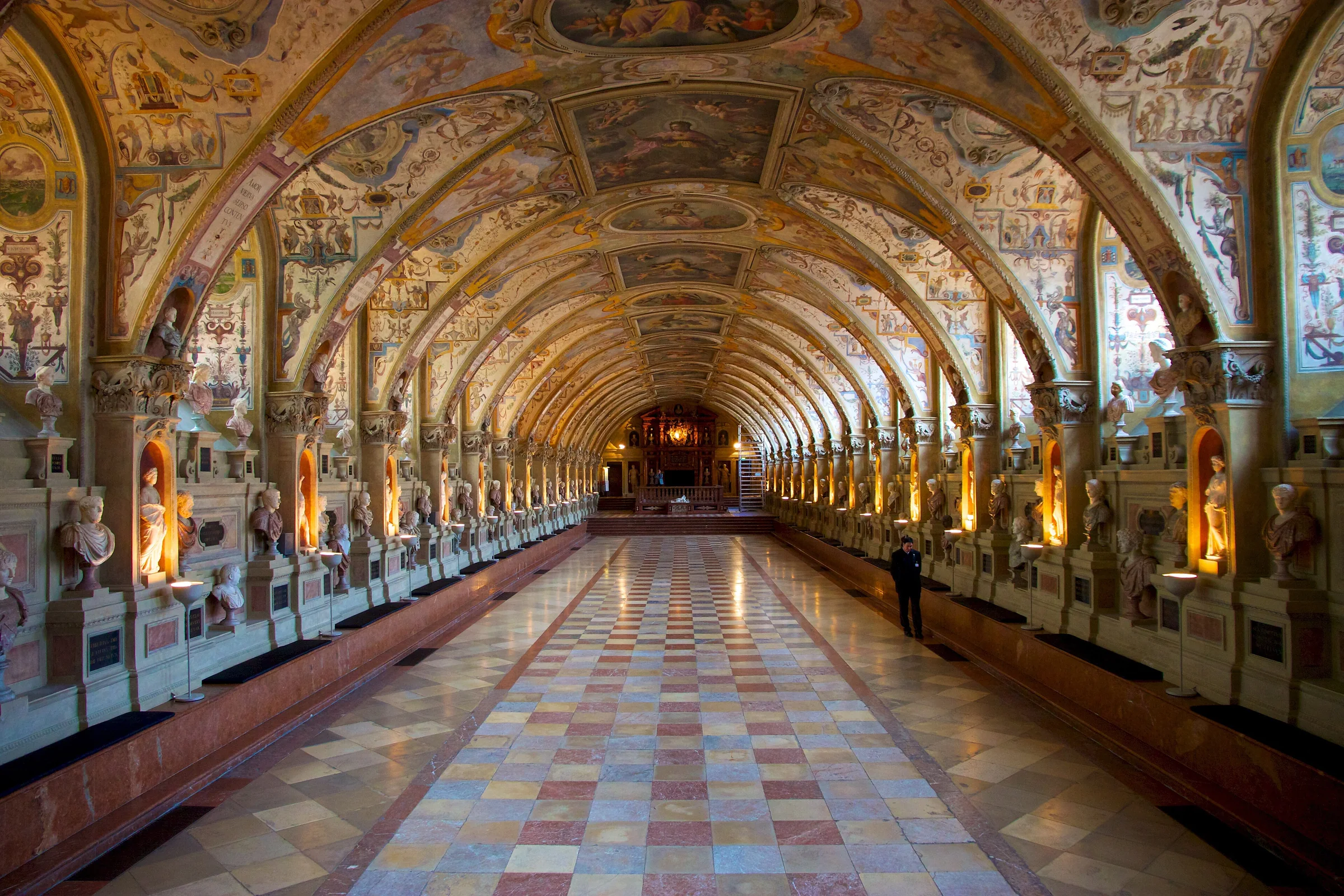
The first great leap from fortress to princely showpiece came in the sixteenth century, when the Renaissance reached Bavaria and the dukes began to collect on a grand scale. Duke Albrecht V, a passionate patron and connoisseur, assembled a celebrated collection of antique sculpture, coins and books, and it was to house the antiquities that the Residenz gained its single most spectacular room: the Antiquarium. Built in the late 1560s, it is an immense barrel-vaulted hall running some 66 metres in length, its ceiling and walls covered from end to end in frescoes. It was conceived as a home for the ducal collection of ancient busts and statues, ranks of which still line its lower walls, and it doubled as a magnificent banqueting hall for court festivities. To this day it is celebrated as the largest secular Renaissance interior north of the Alps, and it remains the showpiece of the whole museum — a room that announces, the moment you step into it, that this was the seat of rulers with imperial pretensions and humanist tastes. The Renaissance dukes did more than build one hall. Under Albrecht V and his successor Wilhelm V the palace acquired new wings and courtyards, workshops and galleries, and the beginnings of the collections that would fill them. The Wittelsbachs of this period saw themselves as heirs to antiquity and as champions of the Counter-Reformation, and both ambitions were written into the Residenz — in classical sculpture on one hand and richly decorated chapels on the other. This was the era in which the palace stopped being primarily a fortress and became instead a stage for dynastic display, a place designed to impress visiting princes and to advertise the sophistication of a family that intended to rise still further in the ranks of the Empire.
Baroque splendour and Rococo jewels
As the dukes became electors, the Residenz kept pace with the changing fashions of European courts, and the seventeenth and eighteenth centuries dressed it in Baroque grandeur and Rococo delicacy. Under Elector Maximilian I in the early 1600s the palace expanded westward with grand new courtyards and state apartments, giving it much of the monumental scale it still has. But it is the eighteenth century that produced the palace's most exquisite interiors. The genius behind them was François de Cuvilliés, a court architect of extraordinary refinement who brought the lightest and most inventive Rococo to Munich. For the electors he created suites of state rooms glittering with gilded carving, mirrors and delicate ornament, where every surface seems to ripple with silvered and gilded decoration. His masterpiece within the complex is the Cuvilliés Theatre, a small court opera house wrapped in tier upon tier of carved and gilded boxes in red and gold — one of the most beautiful Rococo theatres anywhere in Europe, built in the middle of the eighteenth century as a private jewel-box for the electoral court. Alongside the theatre, the electors added ceremonial apartments, galleries and reception rooms intended for the elaborate etiquette of a Baroque court, where access to the ruler was staged through ever more richly decorated antechambers. The Ancestral Gallery, or Ahnengalerie, belongs to this world too: a long gilded hall hung with portraits of the dynasty, asserting the antiquity and legitimacy of Wittelsbach rule through an unbroken line of painted faces. By the end of the eighteenth century the Residenz had become a court palace in the full continental sense — a machine for ceremony as much as a home, its rooms choreographed to display the electors' rank, wealth and cultivation to every visitor who was granted an audience.
The royal century: kings and Neoclassicism
In 1806 Bavaria became a kingdom, and the new royal status demanded a palace to match. The nineteenth century therefore added a final great layer to the Residenz, this time in the cool, ordered language of Neoclassicism rather than the exuberance of the Baroque. The driving force was King Ludwig I, an ambitious builder-king determined to turn Munich into a capital worthy of comparison with the great cities of Italy and antiquity. Working with the architect Leo von Klenze, he extended the Residenz with two major wings in the decades after 1825. One, facing the square now called Max-Joseph-Platz, gave the palace a dignified new royal front modelled on the palazzi of Renaissance Florence. Another added a grand suite of festival and banqueting halls for the ceremonies of the young kingdom. Klenze also reshaped older parts of the palace to suit nineteenth-century ideas of comfort and monarchy, so that alongside the Renaissance halls and Rococo apartments the visitor now finds restrained Neoclassical staterooms with coffered ceilings and columned halls. This royal century completed the Residenz more or less as we know it. By the mid-1800s the palace had reached its full extent: an enormous complex organised around roughly ten interior courtyards, each wing the legacy of a different ruler and a different age, all knitted together at the centre of the city. The kings had inherited a building that already told the story of the dukes and electors who came before them, and they simply added the final chapters. It is this accumulated quality — Renaissance, Baroque, Rococo and Neoclassical wings standing shoulder to shoulder — that makes the Residenz such an unusually complete record of German court architecture across four centuries under one continuous dynasty.
Destruction and the long rebuilding
The Residenz very nearly did not survive the twentieth century. During the Second World War the Allied bombing of Munich fell heavily on the historic centre, and the palace — a vast, densely built complex of old timber roofs and interiors — was among the worst-hit monuments in the city. Successive raids left much of it in ruins: roofs gone, wings burned out, whole ranges of state rooms reduced to shells open to the sky. Photographs from 1945 show a devastated site that many at the time assumed was beyond saving. What followed is one of the great feats of European post-war conservation. Rather than demolish the remains and build anew, Bavaria committed to reconstructing the Residenz, a task that would occupy specialists for decades. The work was painstaking in the most literal sense: surviving fragments of stucco, panelling and fresco were salvaged and catalogued; craftsmen relearned historic techniques to remake gilded carving, marbled surfaces and painted ceilings; and rooms were pieced back together from old inventories, photographs and drawings. Some interiors had, fortunately, been documented or partly dismantled and stored before the raids, which made faithful restoration possible. Piece by piece and room by room, the Antiquarium, the ceremonial apartments and the Cuvilliés Theatre were brought back — the theatre's precious carved boxes had been removed to safety in time and could be reinstalled. The reconstruction stretched across the second half of the century, a slow, expensive and deeply skilled campaign that turned a bombed-out ruin back into a working palace museum. That the visitor today can walk through gilded halls that look centuries old is, in large part, the achievement of the post-war restorers rather than an untouched inheritance — a reminder that the Residenz has been not only built but rescued.
Why the Residenz still matters
What makes the Munich Residenz one of Europe's most important palace museums is not any single room but the density and continuity of what it holds. Few palaces anywhere present four centuries of architecture and interior design so completely under one roof, and fewer still can tie all of it to a single ruling family. In its roughly 130 rooms you move from Renaissance to Neoclassical in the course of an afternoon, tracing the whole arc of the Wittelsbach story through the spaces they actually used. Around this run the great set-pieces: the vast frescoed Antiquarium, the dynastic Ancestral Gallery, the gilded Rococo apartments and the Cuvilliés Theatre. Alongside the state rooms sits the Treasury, the Schatzkammer, one of the most important collections of European goldsmiths' work and royal regalia in existence — crowns, swords, reliquaries and jewels spanning a thousand years, the material inheritance of a dynasty that ruled through most of that time. Together, museum and treasury preserve not just beautiful objects but an entire court culture, kept in the place it was made for. There is also the deeper resonance of survival. This is a palace that was bombed almost to destruction and then patiently rebuilt, so that its splendour carries within it a second, modern story about memory and repair. For the visitor it all adds up to an unusually rich experience: a self-guided walk, at your own pace, through the working heart of a dynasty that shaped Bavaria for centuries, in rooms that are themselves survivors. That combination — long history, artistic depth, and a hard-won second life — is why the Residenz remains, more than a hundred years after the last king left it, one of the essential sights of Munich and one of the great palace museums of Europe.
Frequently asked
Who were the Wittelsbachs?
The Wittelsbachs were the dynasty that ruled Bavaria from the late twelfth century until 1918. Over that long span they held power first as dukes, then as prince-electors of the Holy Roman Empire, and finally, from 1806, as kings of Bavaria. The Munich Residenz was their principal seat throughout.
How old is the Munich Residenz?
Its origins go back to 1385, when a moated castle called the Neuveste was begun on the site. Over roughly the next 450 years successive Wittelsbach rulers enlarged it, turning that fortress into the vast city palace of courtyards, halls and apartments that stands today.
What is the Antiquarium?
The Antiquarium is the showpiece of the Residence Museum: a 66-metre barrel-vaulted hall, frescoed throughout, built in the sixteenth century to house the Renaissance dukes' collection of antique sculpture. It is celebrated as the largest secular Renaissance interior north of the Alps.
Was the Residenz destroyed in the war?
Yes. The palace was very heavily damaged by bombing during the Second World War, with many wings burned out or reduced to ruins. It was saved by a painstaking reconstruction that stretched across decades, in which craftsmen restored the halls, apartments and theatre room by room.
What can I see at the Residenz today?
A visit spans three attractions under one roof: the Residence Museum, with around 130 state rooms including the Antiquarium and Ancestral Gallery; the Treasury, holding crowns, regalia and goldsmiths' work; and the Rococo Cuvilliés Theatre. You can book the museum alone or combined tickets that add the others.