 Skip-the-line available
 A Royal Munich Itinerary Around the Residenz
Build a day or two in the old royal quarter of Munich around the Wittelsbach Residenz, with the city's landmarks, markets and gardens on your doorstep.
The Munich Residenz sits at the centre of the old royal city, so almost everything worth seeing is a short walk or a couple of U-Bahn stops away. Here is how to build a day or two around it.
Start at the Residenz: the heart of royal Munich
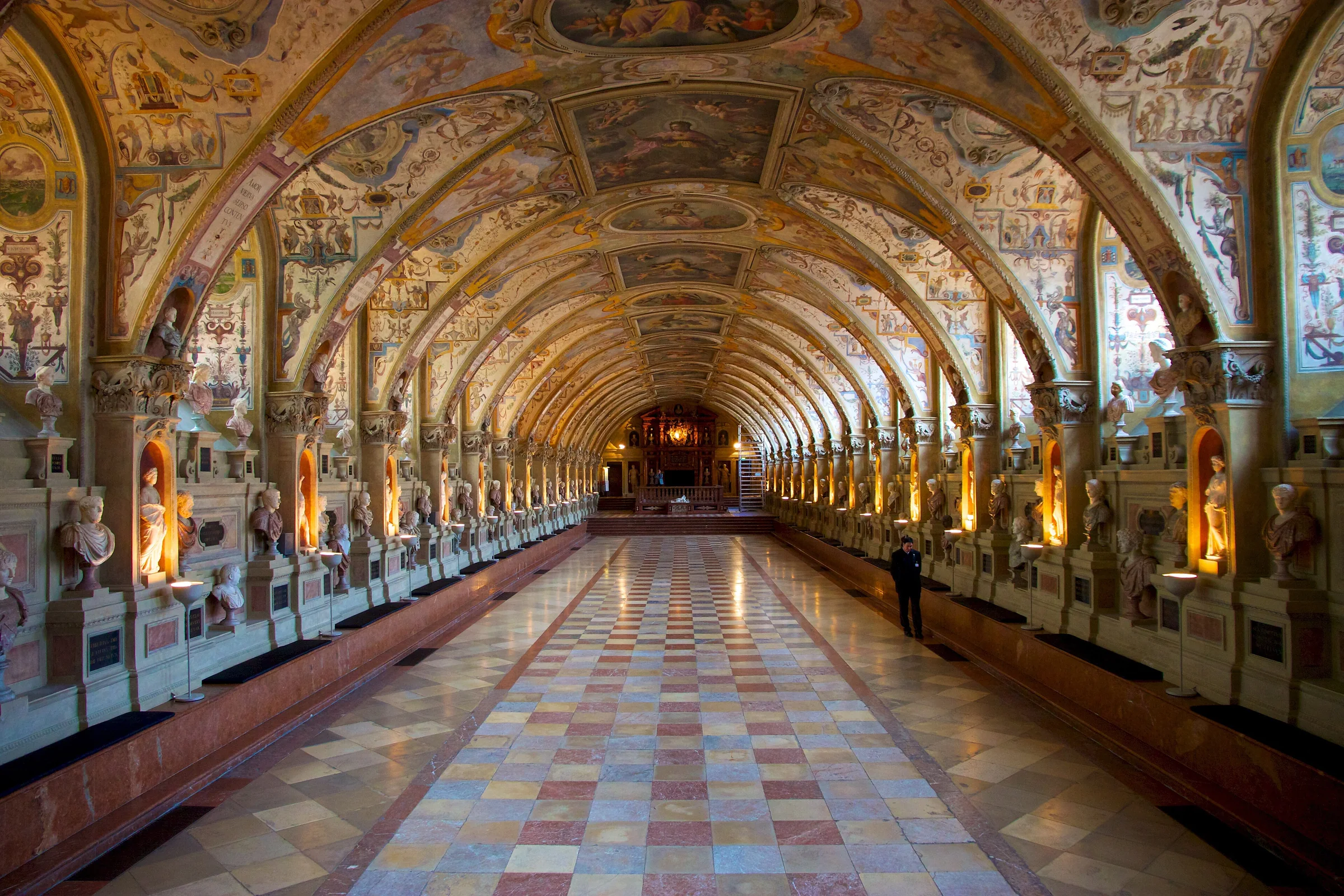
The Residenz is the natural anchor for any Munich itinerary because the Wittelsbachs built their city around it. For roughly 450 years this was the seat of Bavaria's dukes, prince-electors and kings, growing from a small castle begun in 1385 into one of the largest city palaces in Europe. Give it the time it deserves before you wander: the Residence Museum alone runs to around 130 rooms of state apartments, halls and period interiors, crowned by the Antiquarium, a 66-metre barrel-vaulted Renaissance hall frescoed from end to end and still the largest Renaissance interior north of the Alps. The Treasury (Schatzkammer) gathers a thousand years of crowns, swords, reliquaries and regalia, while the Cuvilliés Theatre is a rococo jewel-box of red-and-gold carved boxes. Because the museum is seen self-guided at your own pace, with an audio guide included, you set the rhythm — an unhurried first visit is easy to fill with two to three hours, and the deeper you go into the Treasury and Theatre the longer you will want. Entry is date-based rather than a fixed timed slot, so you keep the flexibility to arrive when it suits your morning and to linger where a room catches you. Book your date ahead and you skip the cash-desk queue with a print-at-home ticket, which matters most in high summer. The palace address is Residenzstraße 1, with entrances on Residenzstraße and Max-Joseph-Platz, and it opens onto the free Court Garden (Hofgarten) on one side and the grand square of the National Theatre on the other — meaning the moment you step out, the rest of royal Munich is already at your feet. Treat the Residenz as your first fixed point of the day and let everything else fall into place around it.
Marienplatz, the Glockenspiel and the Frauenkirche
A few minutes' walk south from the Residenz brings you to Marienplatz, the central square that has been the civic heart of Munich for centuries. Its focal point is the New Town Hall (Neues Rathaus), a soaring neo-Gothic pile whose tower carries the famous Glockenspiel. Twice or three times a day, depending on the season, its carillon chimes and the painted figures spin through a jousting tournament and a coopers' dance drawn from Munich's history — it is touristy, but genuinely charming, and it costs nothing to stand in the square and watch. Arrive a few minutes early, because the crowd builds quickly and the best sightlines fill first. From Marienplatz the twin copper onion domes of the Frauenkirche, the Cathedral of Our Lady, rise just to the west; the brick church is one of the defining shapes of the Munich skyline and its interior is calm, lofty and free to enter. Around the square you will find the pedestrianised shopping streets, the old Peterskirche whose tower rewards a climb with a wide view over the rooftops, and a tangle of lanes that make pleasant browsing between sights. Because Marienplatz sits directly on the U-Bahn and S-Bahn, it doubles as the most convenient hub for the whole itinerary — you can dip out to somewhere further afield and be back at the square within minutes. Treat this as your second anchor after the Residenz: it is close enough to combine with the palace in a single morning, and it puts food, churches and shopping all within a short stroll. Opening times for the church towers and the exact Glockenspiel schedule shift with the season, so glance at the posted times on the day rather than planning to the minute.
Odeonsplatz, the Theatinerkirche and the free Hofgarten
Step out of the Residenz on its garden side and you are moments from Odeonsplatz, the ceremonial square that opens the grand axis of Ludwigstraße. It is framed by two landmarks worth pausing over. The Theatinerkirche glows a warm, unmistakable yellow, its Italianate Baroque façade and high dome a Wittelsbach commission that still holds several of the dynasty's tombs — the interior, all white stucco and soaring space, is free to step into. Across the square stands the Feldherrnhalle, a loggia modelled on Florence's Loggia dei Lanzi and built to honour Bavaria's generals; today it is simply a handsome, much-photographed corner of the city and a useful landmark for getting your bearings. Between Odeonsplatz and the palace lies the Hofgarten, the Court Garden, a formal Renaissance garden laid out in geometric beds around a central pavilion. It is free to all and open to the sky, which makes it the ideal decompression stop between museum rooms and the next stretch of walking: benches, gravel paths, arcades along one side, and often a slow tango or two by the pavilion on a fine afternoon. Because the Hofgarten physically joins the Residenz to Odeonsplatz, you can weave the palace, the garden and both churches into one seamless loop without ever consulting a map. This corner of Munich is where the royal city feels most itself — the streetscape is deliberately monumental, the scale is generous, and everything within it is walkable in a few unhurried minutes. If your Residenz visit runs long and you only have energy for one more thing, make it this: a slow circuit of the Hofgarten and a look inside the Theatinerkirche costs nothing and rounds off the royal quarter beautifully.
Viktualienmarkt and the Hofbräuhaus: eat like a local
You will want to eat somewhere with character, and central Munich makes that easy. Just beyond Marienplatz, the Viktualienmarkt is the city's beloved open-air food market — a permanent spread of stalls selling Bavarian cheeses, cured meats, breads, fruit, flowers, spices and quick hot bites, gathered around a maypole and a small beer garden shaded by chestnut trees. It is the ideal place to assemble an informal lunch: grab a Leberkäse roll or a pretzel, find a bench, and watch the market go about its business. Traders keep their own hours and most wind down by early evening, so it works best as a daytime stop slotted between sights rather than a dinner plan. For the evening, the Hofbräuhaus is the obvious pilgrimage — the vast, vaulted beer hall a short walk east of Marienplatz, where long communal tables, a brass band and litre steins deliver exactly the boisterous Bavarian scene visitors come for. It is unashamedly famous and busy, but the ceiling frescoes, the historic rooms and the sheer theatre of the place earn the visit; go hungry, and expect hearty plates of roast pork, sausages, dumplings and sauerkraut. If you would rather escape the crowds, the surrounding streets and the market's own beer garden offer quieter tables with the same regional cooking. Both spots sit inside the same compact core as the Residenz and Marienplatz, so neither pulls you away from the itinerary — you can fold a market lunch and a beer-hall dinner around a full day of palaces and churches without adding any real travel. Prices and exact hours vary from stall to stall and season to season, so treat these as places to graze and soak up the atmosphere rather than fixed reservations, and let your appetite set the timing.
The English Garden: royal Munich's great green lung
When you have had your fill of gilded rooms, the English Garden is the perfect counterweight — one of the largest urban parks in the world, laid out in the naturalistic English landscape style and stretching north-east from the edge of the old royal quarter along the River Isar. It begins close to the Residenz and the Hofgarten, so you can drift into it on foot as a natural extension of the day rather than a separate excursion. Inside you will find broad meadows, wooded paths, streams and a scattering of landmarks: the Chinese Tower (Chinesischer Turm) with its big, cheerful beer garden; the Monopteros, a small Greek-style temple on a rise that gives a lovely view back over the spires of the city; and the Kleinhesseloher See, a lake you can circle in half an hour. One quirk always draws a crowd — near the southern entrance, a standing river wave on the Eisbach draws surfers who ride it in wetsuits year-round, an oddly hypnotic thing to watch from the bridge. The park is free and open at all hours, which makes it ideal for whatever the itinerary needs it to be: a morning stroll before the museums open, a lazy beer-garden afternoon, or a wind-down walk as the light softens. On a warm day, a couple of hours here is one of the great simple pleasures of Munich. Because it hugs the eastern side of the centre, you can enter from near Odeonsplatz, wander as far as your legs allow, and pick up a tram or U-Bahn back when you are ready — no need to retrace your steps. Wear comfortable shoes and let yourself get a little lost; the paths always lead back.
Nymphenburg: the Wittelsbachs' summer palace
For the one sight worth leaving the centre for, make it Nymphenburg — the Wittelsbachs' summer palace, and the natural counterpart to their city Residenz. Where the Residenz is a dense urban palace grown room by room over centuries, Nymphenburg is its expansive rural mirror: a long Baroque frontage spread wide across formal gardens and canals on the western edge of Munich. Seeing the two together tells the fuller story of the dynasty — the working seat of power in the heart of the city, and the pleasure palace where the same family retreated in summer. The grand central hall, the sequence of state and private rooms, and the surrounding park with its fountains, tree-lined avenues and smaller garden pavilions make an easy half-day, and the parkland alone is a delight to walk. It sits a little further out than the other stops on this itinerary, but Munich's transport makes it painless: a tram or bus ride from the centre delivers you close to the gates, and the journey is short enough to slot into an afternoon. Because it is a separate site with its own arrangements, treat it as its own outing rather than something to squeeze between city-centre sights — give it a clear block of time and let the Residenz and Nymphenburg bookend your understanding of royal Munich. If you are choosing between the two on a tight schedule, the Residenz is the essential one for its central location and its concentration of treasures, but pairing them is the connoisseur's move. Check the current opening arrangements before you set out, since a palace on the edge of the city keeps its own schedule and you will want to arrive with enough of the day left to enjoy both the interiors and the grounds.
One-day and two-day plans, and getting around
For a single day centred on the Residenz, start at the palace when it opens and give it your freshest hours: the Residence Museum first, then the Treasury, adding the Cuvilliés Theatre if you have chosen the see-everything ticket. Emerge into the Hofgarten, cross to Odeonsplatz for the Theatinerkirche, then walk down to Marienplatz to time the Glockenspiel and look inside the Frauenkirche. Graze lunch at the Viktualienmarkt, spend the late afternoon strolling the English Garden, and finish with dinner at the Hofbräuhaus. That single loop covers the royal core almost entirely on foot. With two days, keep day one for the Residenz and the city-centre landmarks above, and give day two to Nymphenburg in the morning — the summer palace and its park — returning to the centre for whatever you missed, a slower market lunch, a tower climb at the Peterskirche, or a longer wander in the English Garden. Getting around could hardly be easier. The Residenz's nearest stations are Odeonsplatz and Marienplatz, both served by U-Bahn and S-Bahn, and almost every stop on this itinerary is either walkable from the palace or a few minutes on the same lines. From Munich Hauptbahnhof the palace is roughly a fifteen-minute walk or a short U-Bahn ride, and Munich Airport connects to Marienplatz and Odeonsplatz by S-Bahn (the S1 and S8) in about forty minutes. A day ticket covering the inner zones typically pays for itself once you make a few hops, and trams fill in the gaps the trains miss — Nymphenburg among them. Because entry to the Residenz is valid for your chosen date rather than a fixed slot, you can shape the day around the trains and the weather rather than racing a clock, which is exactly how royal Munich is best enjoyed.
Frequently asked
How much time should I set aside for the Munich Residenz itself?
Plan two to three hours at a minimum. The Residence Museum alone has around 130 rooms, and adding the Treasury and the Cuvilliés Theatre easily fills half a day. Because the visit is self-guided at your own pace with an included audio guide, you decide how long to linger in each part.
Can I see the Residenz and Marienplatz in the same morning?
Yes. Marienplatz is only a few minutes' walk from the Residenz, so many visitors do the palace when it opens, then walk down to catch the Glockenspiel and step inside the Frauenkirche. The whole royal core is compact and best explored on foot.
Is Nymphenburg worth adding to a Residenz visit?
If you have a second day, yes. Nymphenburg is the Wittelsbachs' summer palace and the natural pairing with their city Residenz, telling the fuller story of the dynasty. It sits further out but is an easy tram or bus ride, making a comfortable half-day outing with its gardens.
Which nearby sights are free?
Several. The Court Garden (Hofgarten) beside the palace is free to all, as is standing in Marienplatz to watch the Glockenspiel. Entering the Frauenkirche and the Theatinerkirche costs nothing, and the English Garden is a free public park open at all hours.
Do I need to drive, or is public transport enough?
Public transport is more than enough. The Residenz is served by the Odeonsplatz and Marienplatz U-Bahn and S-Bahn stations, and almost every stop on this itinerary is walkable or a few minutes away by train or tram. A day ticket for the inner zones usually pays for itself quickly.